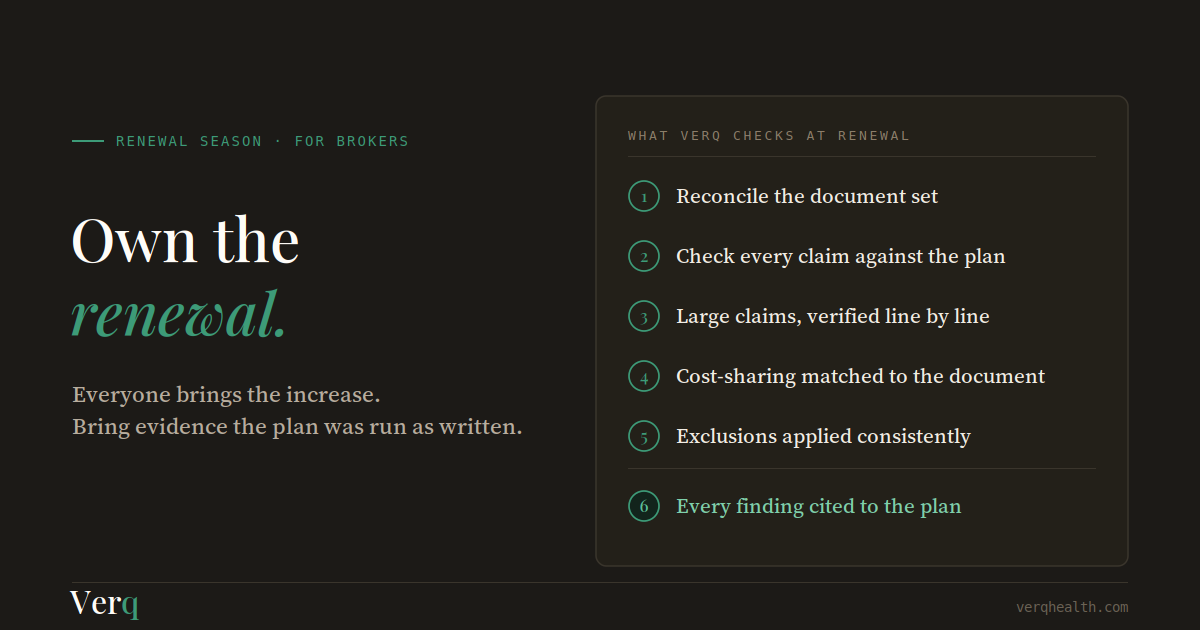
Six items, in order
- 1. Reconcile the document set. SPD, wrap or master plan document, this year's amendments, the SBC. Do they agree with each other — and were the amendments actually incorporated? Every downstream check depends on knowing which words govern.
- 2. Pull the claims. The CAA banned the gag clauses that used to keep claims data locked inside carriers and TPAs. The plan is entitled to its own data. Exercise the right — a renewal built only on the TPA's summary reporting is a renewal built on trust.
- 3. Check the large claims against the plan. Prior authorization on file, exclusions applied, cost-sharing per the document — for every claim at or near the stop-loss attachment point. The stop-loss carrier will run this exact check before reimbursing. Run it first, while errors are still correctable.
- 4. Verify stop-loss alignment. Attachment points, contract basis, and — the one that bites — whether the stop-loss policy actually mirrors the plan document. A benefit the SPD covers but the policy excludes is the employer's cost, discovered at the worst possible time.
- 5. Confirm the compensation file. CAA disclosures on hand — the vendors' and your own — and the client's reasonableness review documented. Post-Cunningham, that file is a defense exhibit, not a formality.
- 6. Write down what you reviewed. What was checked, what was found, what was resolved, what's carried forward. The renewal that ends in a documented record is a different product from the renewal that ends in a spreadsheet.
Why this wins the meeting
Every incumbent delivers the increase. Almost nobody delivers evidence the plan was run as written. The broker who walks in with items 1–6 closed isn't presenting a renewal — they're presenting oversight, on the record. That's the deliverable the room can't tell apart on promises alone.
This article is for general informational purposes only and is not legal advice. Court decisions and filings discussed involve particular facts and procedural postures; allegations are not findings of wrongdoing. Consult qualified ERISA counsel regarding your specific obligations.
See what a document reconciliation actually surfaces: a real SPD audit, anonymized — cost-sharing conflicts, HDHP qualification risks, provisions a claim decision can't defend — each cited to the page.
Download the sample report →