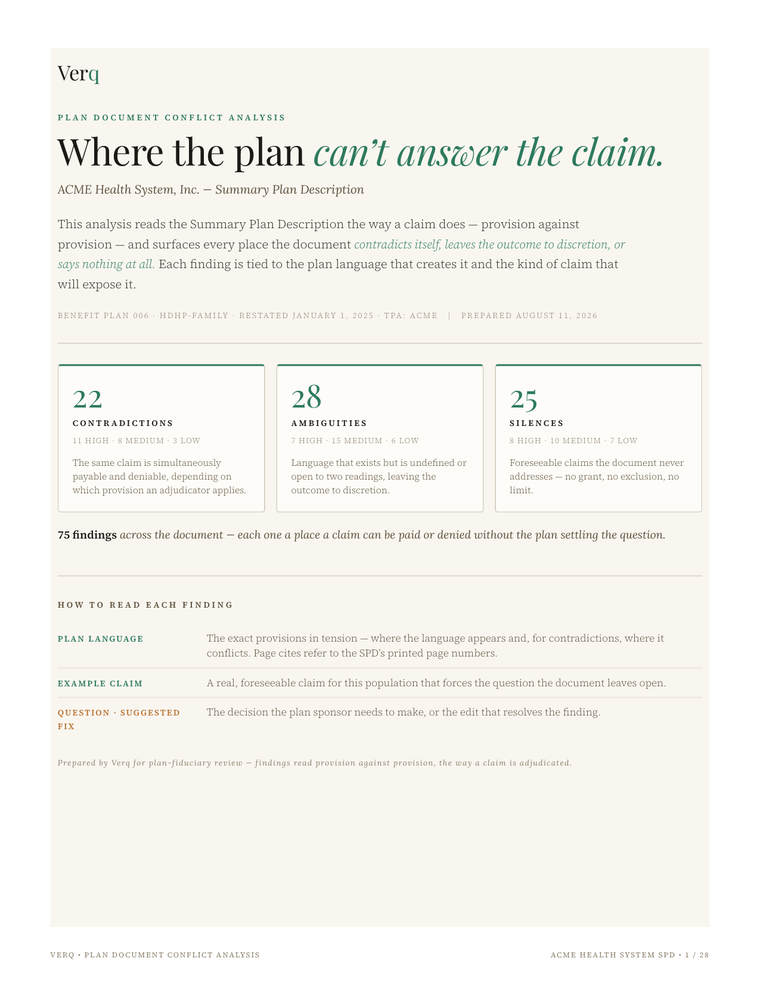
All four are high-severity contradictions in how deductibles, out-of-pocket maximums, and HDHP qualification are defined — places where the same claim can be paid or denied depending on which provision an adjudicator applies.
Real audit · anonymized
Fix before renewal
This plan gives two answers to the same family’s claim.
When one person in a family has a big claim early in the year, the document says in one place that their deductible is met — and in another that nothing is met until the whole family’s is. The administrator has to pick one. The difference is thousands of dollars on that one claim, and it repeats with every such claim.
From the document itself
Out-of-Pocket Expenses · p.16
“A Deductible applies to each Covered Person up to a family Deductible limit.”
Schedule of Benefits · p.4
“The FULL Family Deductible Amount Must Be Met Before The Plan Will Begin Paying.”
→ One sentence settles it: say which design you meant. Best done before renewal, while the document is already open.
Real audit · anonymized
Fix before renewal
The “most you’ll pay” protection has two ceilings — and one is too high.
The document describes the out-of-pocket maximum as protection for each person. The Schedule says the full family maximum — $10,000 or $12,000 depending on tier — must be met before the plan pays 100%. Read that way, one seriously ill family member could keep paying past the individual limit federal rules set for the 2025 plan year (about $9,200). That is a compliance exposure as well as a contradiction.
From the document itself
Out-of-Pocket section · p.16
“…the most the Covered Person pays each year.”
Schedule of Benefits · p.4
“Full Family Out-Of-Pocket Maximum Amount Must Be Met Before The Plan Will Begin Paying Covered Expenses In Full.”
→ Add an individual ceiling at or below the federal limit, and make both pages say the same thing.
Real audit · anonymized
Fix before renewal
Two rows in the schedule read as if they were swapped — and one puts every employee’s HSA at risk.
This is a high-deductible plan, which means almost nothing can be paid before the deductible. Yet the schedule pays 80% of bariatric surgery with no deductible mentioned, while the inexpensive informational seminar is paid only after the deductible. Administered as written, the surgery row could disqualify the plan as an HDHP — and with it, every enrollee’s ability to contribute to an HSA.
From the document itself
Schedule of Benefits · p.9
“Bariatric Surgery – All Other Services: Paid By Plan 80%” (no deductible language) · “Informational Seminar: Paid By Plan After Deductible 100%”
QHDHP declaration · p.4
The plan declares itself a qualified high-deductible plan; IRS rules allow only preventive care to be paid before the deductible.
→ Confirm the intended design — almost certainly seminar deductible-waived, surgery after deductible — and correct the two rows.
Real audit · anonymized
Fix before renewal
A travel-vaccine row contradicts the plan’s own definition of itself.
The schedule pays foreign-travel immunizations at 100% with the deductible waived. But those shots are not on the list of preventive care a high-deductible plan is allowed to pay before the deductible — and this plan declares itself a high-deductible plan on page 4. The row even argues with itself: “After Deductible … (Deductible Waived).” One yellow-fever shot, paid as written, invites a question about every participant’s HSA.
From the document itself
Schedule of Benefits · p.10 & p.12
“Foreign Travel Immunizations: Paid By Plan After Deductible 100% (Deductible Waived)” — Tiers 1–2
QHDHP declaration · p.4 · Glossary · p.108
The plan’s own definition of preventive care follows the IRS list for qualified high-deductible plans; travel immunizations are not on it.
→ Either apply the deductible to travel immunizations or get tax counsel to sign off on the exception — then fix the row.